




The Flight Time Nobody Talks About: What Yuzuru Hanyu’s Jumps Teach Us

Watch a great jump, and your eye goes straight to the rotation. Count the turns, check the landing, move on. But the jump was decided a split second earlier, in the moment the blade pushed off the ice. That is when the skater chooses how high they will go, how long they will stay in the air, and how much time they will have to finish the rotation.
The moment that writes the whole jump
Once the blade leaves the ice, the jump's path is fixed. The skater can no longer change the arc's shape in the air. The take-off is the only chance to set it.
Two speeds make that happen:
Vertical speed is the lift. It comes from extending the body during the push: the knee, hip, and ankle opening together. It sets the height and the time in the air.
Horizontal speed is the glide. It comes from the approach and the weight transfer. It sets how far the skater travels. Without air resistance, it stays the same from take-off to landing.
The angle at which the skater leaves the ice, the launch angle (or take-off angle), is simply the balance between these two speeds. Push up hard, and the angle rises. Keep the speed forward, and it flattens.
Two ways to build a jump
This balance creates two very different jumps.
Distance-dominant: strong forward speed, lower angle. The arc is flatter, the landing carries more flow, and the jump feeds smoothly into what comes next. It is often the right choice for the first jump of a combination.
Height-dominant: more forward speed turns into lift through an explosive push. The arc is higher, the air time is longer, and there is more time to rotate. The price is a heavier landing, so the body must be perfectly stacked over the landing edge.
Neither is better. The best jump matches the skater’s power, the element, and the goal.
What Hanyu shows us
Yuzuru Hanyu’s jumps are often praised for their flight and their landings. Look at the take-off: the push is clean, the body stays organized, and the rotation begins without visible strain. He does not seem to fight the jump. He builds a launch that gives the rotation room to happen.
What this means on the ice
For coaches: film the take-off from the side. Check whether the push comes from the extension or from the arms and shoulders, and whether the skater’s horizontal speed is turning into lift.
For skaters: more height rarely comes from more force. It usually comes from a fuller extension and a better timing of the free leg.
For parents: a jump that looks low may be a take-off issue, not a lack of courage or strength.
Good jumps are not finished in the air. They are set on the ice, a split second before the blade leaves it.
Want to go deeper?
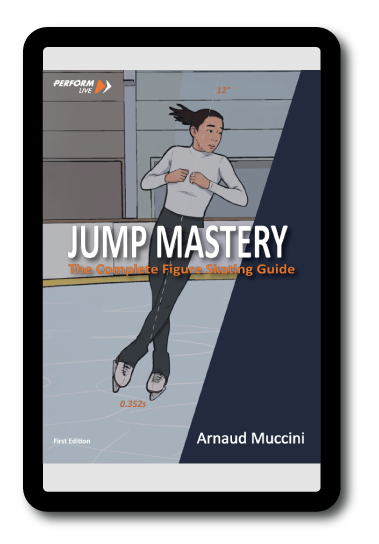
This article is drawn from Jump Mastery: The Complete Figure Skating Guide by Arnaud Muccini (Perform’Live, first edition, August 2026).
The book breaks down take-off, flight, landing, and rotation through the physics behind each movement, and it is built on a database of 80 to 100+ jumps performed by elite skaters.
If this article made you want to see how the best take-offs really work, the full guide goes much further, with step-by-step analysis, illustrations and practical remediation exercises.
Get the book: Jump Mastery: The Complete Figure Skating Guide
Comments